
A Buzz open-protocol team relay with memory and in-channel assistance.
The same chat, the same clients, the same open protocol — with channels that remember what was said, answer questions about it, and can run entirely on infrastructure you control.
Buzz is an open team-communication app built on an open protocol: channels, threads, direct messages and shared media, with a free desktop client and a relay — the server every client connects to — that carries the messages and enforces who belongs to which group. LoungeBuzz is a relay for that protocol, written on the Lounge runtime. Point the client you already use at it and everything works the same way; what changes is what the relay itself can do.
The free Buzz desktop app runs against LoungeBuzz end to end, as does any standard client for the protocol — including native support for groups. No bespoke app to install, no migration to plan.
Identity is a keypair you hold. Groups, membership and history are stored in an open format. Identity and conversation data are therefore not tied to a proprietary client.
Run it in your own cloud, or use a managed deployment. Both expose the same relay protocol, so changing the deployment model does not require a client migration.
A relay's job is to accept messages, check who is allowed to post them, store them, deliver them to subscribers, and route abuse reports to the people who handle them — LoungeBuzz does all of that to the letter of the protocol. On top of it, the relay also remembers what was said and can reason about it, with the model of your choice, including models running on your own hardware so conversations need not leave your environment.
Persistent, searchable memory across every conversation. Recall combines keywords and meaning, and runs against local embedding models when privacy matters.
Ask a channel what it knows — "what did we decide about the launch?" — and get an answer grounded in what was actually said, with the history behind it rather than a guess.
A periodic check-in that identifies open items and presents them to the channel.
Your content policy, your rules, applied consistently and automatically as conversations move.
Evaluates a message against routing policy and brings additional recipients into the conversation when the policy calls for them.
Bring outside conversations in from the platforms your teams already use. Once connected, everything else applies — the same memory, the same policy, the same assistance.
LoungeBuzz is written the way any Lounge application is written — as a flow description. This is the relay's own file: an incoming message walks the policy lane, commits to the store, and is offered to every live subscription. The rules of the relay are readable, in one place.
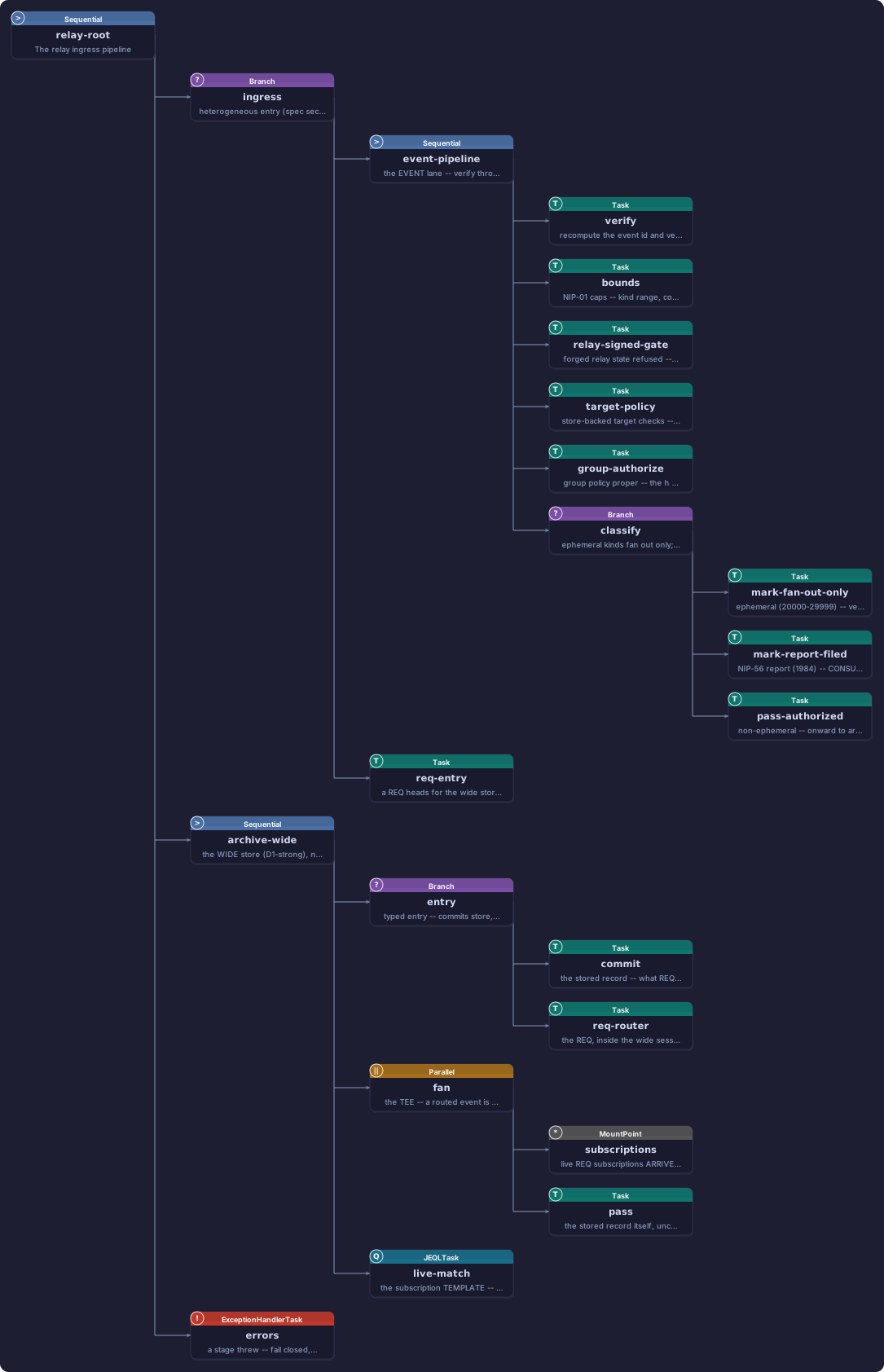
A policy you can audit. Signature checks, size caps, group authorization and the refusal of forged relay state are named steps in a readable order — not behaviour buried across a codebase.
Subscriptions as first-class flow. Each live subscription attaches to the tree as its own branch, and every stored message is offered to all of them from a single declared query.
Per-channel ordering. Conversations are the runtime's unit of ordering, so messages in a channel are processed in order without the relay writing a line of concurrency control.
One purchase, two perpetual licences — the Lounge PRO engine and LoungeBuzz running on it. $1,699 per instance. Nothing recurs, nothing expires, and nothing is metered.
Adding people to a channel does not add to the bill. Cost follows the instances you run, not the size of your team, so inviting the whole company to a channel is a decision about the conversation rather than about the invoice.
The price covers both licences — the engine and the application — so there is no second thing to buy and no way to end up with one and not the other.
There is no cluster edition of LoungeBuzz, and that is deliberate: its connections and channels do not nest and presence is process-global, so it runs as a single node with failover rather than as a fleet. Selling you a cluster licence would be charging for a capability the application cannot use.
LoungeBuzz is an application of the Lounge runtime — the same declarative engine, the same operational guarantees underneath your conversations.
Every message is committed to a managed database before it is acknowledged, and the relay itself runs as replaceable nodes. If the database is healthy, replacement nodes recover the committed state after a restart, scale operation, or failover.
Encrypted in transit and at rest, with private groups and encrypted direct messages passing through sealed — the relay carries them without reading them. Channel content is server-managed on purpose, so retention, search and compliance tooling keep working; local models mean it need never leave your infrastructure.
LoungeBuzz ships as a container image and a small deployment kit — two compose files, an environment template and a README. The relay comes up on bundled PostgreSQL with no external services required.
tar xzf loungebuzz-kit-1.0.0.tar.gz && cd loungebuzz-kit-1.0.0
cp .env.example .env
openssl rand -hex 32          # put the result in RELAY_IDENTITY_KEY
docker compose up -d
curl -s localhost:8080/q/health
RELAY_IDENTITY_KEY is required rather than
optional, deliberately. It is the relay's own signing identity — the key
clients pin and verify relay-signed events against. A relay that invented a
fresh one at every restart would invalidate everything it had already
signed, so the kit refuses to start without one instead of quietly
generating a throwaway.
curl -LO https://github.com/lounge-labs/lounge-dist/releases/download/loungebuzz-v1.0.0/SHA256SUMS
curl -LO https://github.com/lounge-labs/lounge-dist/releases/download/loungebuzz-v1.0.0/SHA256SUMS.asc
gpg --verify SHA256SUMS.asc SHA256SUMS
shasum -a 256 -c SHA256SUMS
Signed with CC88 D45F 14FE F07C 0635 C8D0 D882 1C4A 7283 892C.
The image is ghcr.io/lounge-labs/loungebuzz:1.0.0, published for
linux/amd64 and linux/arm64.
Most relay software in this ecosystem is open source. LoungeBuzz is supported, Buzz-compatible community infrastructure on a commercial runtime — with someone accountable for it.